


This is chapter 13, have you read chapter one yet?

Her mouth fell open. “Funeral?” But Apa just nodded.
And something pushed under her arm.
Another arm, hooked—two clubbed fingers. Ginny tugged and Simonee fell into step. Looking back, Mariem just gave her a wave—not even flapping, just one jerk of the wrist.
She turned forward as they dove into the crowd. “Where are we going?”
Ginny stopped, removed her arm, made a small fist of her two fingers, then a C with the other and tapped the thumb on the fist.
Her implant grabbed it, sorted it, saved it but Simonee just shook her head. Ginny sighed, made a V with her two fingers and flicked it twice from her eye.
Before Simonee could object, Ginny had her by the arm again, pulling.
When they stepped out of the terminal into daylight, she... forgot everything.
Looking up, her shoulders pinched, her stomach rolled, her jaw fell and bit, fell and bit—the tessellating panels of glass shrunk and faded, disappearing above the... Clouds.
Clouds inside?
She’d seen moisture fog in sudden depressurization, steam on windows, mist in the gardens but whole ass clouds?
And as her gaze dropped, the openness seemed to go on forever. Buildings bumped up here and there, a big one at the center, then walkways suspended on cables and smaller structures hanging like upside-down tear drops of sparkling glass. Little trees, green in circles, fanning out from a glistening pond—an island at the center growing... green sticks?
Outer space was one thing—eternity spread out on the other side of a faceplate, or a window. Here, nothing separated her from all this open air and she just—stopped.
Ginny tugged, but Simonee’s eyes wouldn’t leave it be.
A soft touch on her face, head turning, grey eyes, brown cheeks. Laughter—Ginny could laugh.
She closed her eyes and shook. “Sorry, just... wow. Now what?” Her cheeks stretched till they ached—she wanted more.
Ginny pointed to the ground, then to a little arch poking out of it—that she understood. A stream of people were walking down into it, each one... bald like Ginny and—shit—all in onesies. Walking in twos or fours. Many holding hands. Some hands clasped out front.
Down into the arch, a tunnel—and the sky went away. Pale blue panel lights lit the stark polymer walls—shiny, smooth, her splotchy reflection wobbling around struts and joists. Branches split left and Ginny kept them right.
Some of the onesies glanced her way—and stared. Dim tunnel, her eye glowing bright purple. She fought her eyes forward, tossed her hair out front—winked it shut for all the good it would do.
The tunnel swirled and dove and broke into daylight again—rails lining a catwalk that hovered over a chasm of glass triangles, sloping down and in, over roiling clouds, tawny and gold. Lightning flitted between them like tiny sparks. She gripped the rail, forcing her legs to move.
Ginny squeezed her arm, pulled her gaze, pointing to the path ahead—which disappeared into another tunnel, but lighter.
And they about collided with a crowd of onesies swarming a set of doors—colored glass triangles in patterns.
The tunnel continued left, but Ginny nudged her way into the crowd; onesies parted in deference.
A pale construct held the door, took one look and signed at Ginny—pointing at Simonee in the process. It was a male—bald like the rest but a bit broader and the onesie shaped him different. She’d never met a male. They weren’t common.
Then Ginny did that thing Apa did, covering her eye—and the boy construct raised his brow, grinned.
He let them pass.
Onesie after onesie parted for Ginny with Simonee in tow, and the tunnel broke open again.
A gasp tore itself from her chest.
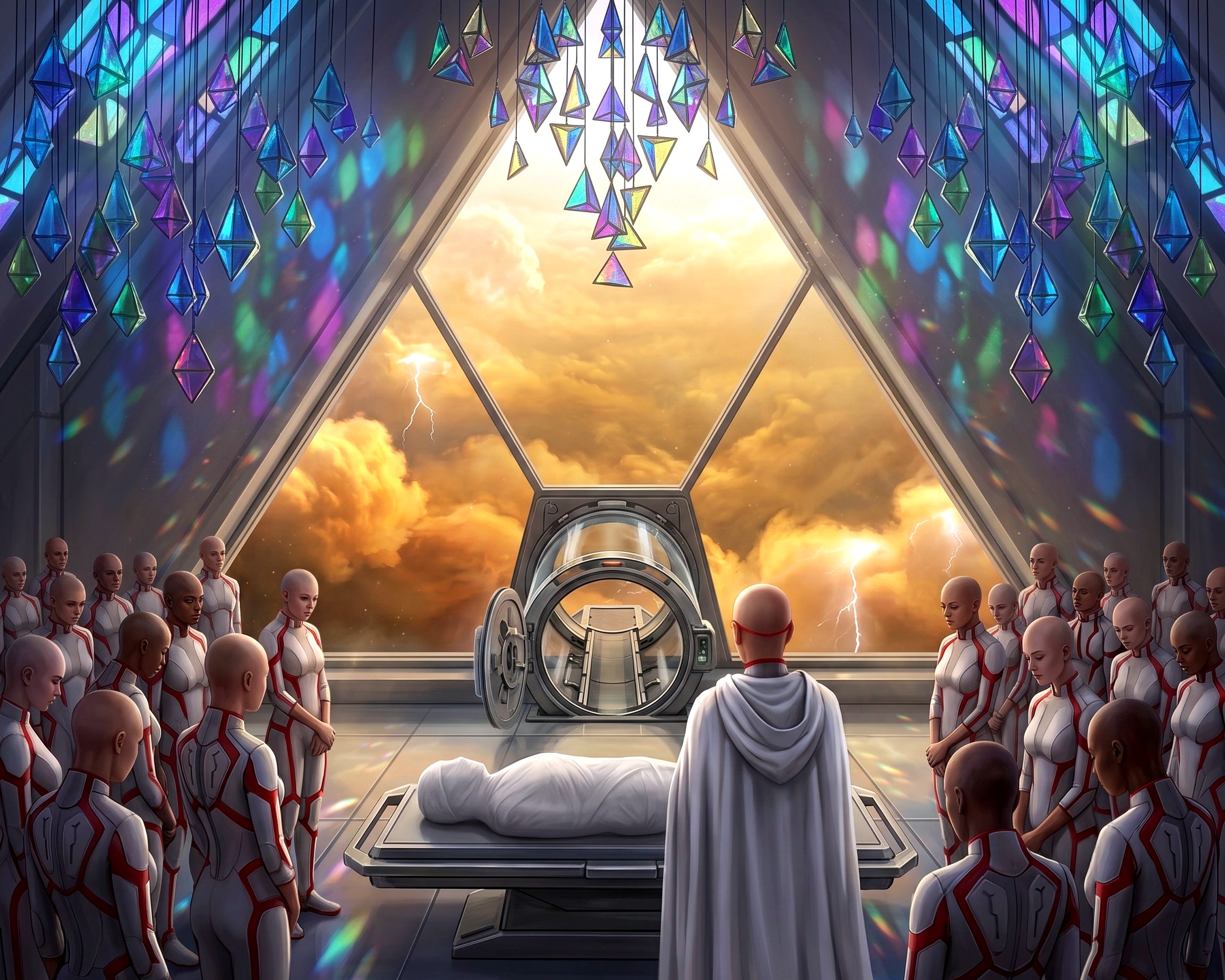
A giant amphitheater—one whole glass triangle tall—smears of blue, green, red, purple flying everywhere. The color wasn’t in the window but floating in front of it, colored glass pendants, sharp angles, dangling and spinning, catching the day, splashing color over the crowd assembled in tiers along the back of an arched wall.
But her teeth bit down and her lips pulled thin when she saw what lay at the bottom of the window—a hole.
Not an open hole, but a tube in the glass, sloping down, ending in an aperture. A bier sat against it with a small billet of white cloth laid on top, shaped like a body. It was a body.
She turned to Ginny. “Who is it?” Why did she keep doing that? She wouldn’t understand.
But Ginny made that same sign, hands up, rolling down.
And a voice filled the murmuring hall with the answer.
“Chance left us too soon.” A woman’s voice—confident, and maybe... familiar.
She looked—a figure now stood on the platform, draped in a white cloak, hooded. She couldn’t see her face at this angle, not more than a nose, lips.
And mumbles wove through the crowd—nearest to her, she could make out whispers.
“Such a surprise.”
“A pity.”
“Why? Chance was weak—we all knew this was coming.”
“But the way they found her—how’d she get all the way up there?”
“She pushed herself too hard—that’s what killed her.”
Ginny blew sharp through her teeth and glanced about—the nearest chatter died.
But Simonee risked a question, “Is that—”
Ginny silenced her with a simple hand over her eye. Molly—that meant, Molly. The other thing, the hands cupped up and down, that was Chance.
And that voice rose again like an itch in her neck. But it was smooth—English—practiced, and it carried an accent like... A chill shot up her groin and into her belly.
“Chance came to us last year—you all remember her naming. We agreed that she might not survive her frailties but... she had a chance.”
Molly turned and stepped slow to the bier, rested a hand on the bundle—so small even for a construct.
And a set of eyes pulled Simonee’s gaze to the edge of the platform. Another male—staring at her. But this one was taller than the rest—bronze skin, dark eyes, a fine scar down his face that curled into the dimple of his grin—gulp.
His smile warmed her cheeks even though it didn’t belong here—maybe because it didn’t. She knew others were looking too—furtive glances catching the purple glow she tried to hide under her hair. But this gaze was locked and her lips wanted to match his.
But Molly’s words—”She always believed—such strong faith in Mother.”—stole her from his grip.
Mother. And the crowd murmured again.
Some grumbles. Some hosannas—”Mother see me, see me pious.”
And her arms crossed, elbows tucked.
Molly pulled back the hood—pale head stubbled black, lined by a red elastic strap. “She believed she’d return to Mother, as many of us once did—to join in peace. She saw her suffering as her service to that promise.”
The hosannas rose; the grumbles retreated. Simonee closed her eyes—she just wanted this to be over.
“But I don’t believe that.” Molly almost whispered this, though it carried still.
Simonee’s eyes shot open. Hosannas harshened to grumbles; previous grumblers nodded; Molly stroked the shroud where Chance’s head would be.
Then she glided forward, flipped a lever by the tube and the aperture opened. The bier spun, rolled on a track. Chance slid into the tube.
Molly’s voice rose again. “Either way, here we break the ownership of our bodies as feed, and tender our young sister to the fury of her final home.”
The inner aperture closed, and the outer one opened, the shroud flagging in the wind as the body slid—fell.
And Molly spun to face her congregation; Simonee retreated, back colliding with the constructs behind her.
The strap held a red patch over Molly’s right eye, the other a ring of brightest blue—Cerulean 9. And her face...
The panic hit straight at her heart, lungs not working. She clutched her chest, pushing through bodies—had to get away.
Out the door, gripping the guardrail. A hand landed on her shoulder, but she batted it away—kept walking, stumbling, moving. She wanted to run but her legs felt like stilts, and her heart wouldn’t beat right, skipping, halting, blood moving where it didn’t belong.
Collapsing, leaning, gasping—the glossy wall gleamed violet under her implant. And in the shine she saw herself warped, marred—an eye given, an eye replaced.
Her sacrifice.
But that face, her face—their face.
And those lovely blue eyes—the memory ripped in and out, pulling her chest tighter. Her throat ached, her stomach rose, pushing bitter vomit into her mouth, then pouring, splashing onto the walk—sour in her nose.
Why? Why? She left them all to die.
She left... her to die.
But somehow, Molly had lived.
New to Simonee’s story? The Cannibal of Cloud Ball 9 is Book Two of The Girl with the Cybernetic Eye. Book One—The Ice Princess of Enceladus Station—is complete and free to read on Substack here. Or get the eBook here for a convenience fee that supports the author.